The Pattern
Of all the symbols that sacred geometry has produced across its long history, none is more widely recognised, more deeply studied, or more philosophically resonant than the Flower of Life. It is a deceptively simple pattern — nineteen overlapping circles arranged in a precise hexagonal formation, enclosed within a larger boundary circle — yet within that simplicity lies an extraordinary density of information. Every major geometric form that sacred geometry explores can be found encoded within it. Every proportion, every angle, every relationship emerges from this one diagram as naturally as a flower unfolds from a seed. This is not metaphor; it is mathematics. The Flower of Life is a geometric generating engine, a single pattern from which the entire language of sacred geometry can be derived.
The name itself is ancient in spirit if not always in precise textual usage. The form has been known under many names across many cultures, but the underlying recognition is always the same: this pattern is somehow fundamental, somehow prior to the particular cultural framework through which it is being observed. It appears wherever human civilisation has reached sufficient geometric sophistication to construct it — from the granite walls of ancient Egyptian temples to the bronze lions of imperial China, from the sketchbooks of Renaissance masters to the molecular structures revealed by twentieth-century physics. Each new context of discovery adds another layer to what the Flower of Life means, another facet of why it keeps appearing wherever careful eyes observe the geometry of the natural world.
To understand the Flower of Life is to understand that geometry is not merely a tool for measuring and building — it is a language for describing the deep structure of reality itself. When we ask why this particular arrangement of circles should recur so persistently across culture and epoch, we are asking a question that sits at the intersection of mathematics, physics, philosophy, and art. The answer, as we shall see, is both beautifully simple and infinitely deep: the Flower of Life is not an arbitrary design but the natural consequence of asking how equal circles can most efficiently and harmoniously fill a plane. Nature answers that question the same way every time, whether the actor is a geometer drawing with compass and straightedge, a bee constructing a honeycomb, or a carbon atom forming a layer of graphene.
The journey through the Flower of Life begins, as all sacred geometry begins, with the circle. A single circle drawn on a blank surface establishes a centre, a radius, and a boundary. It creates the most fundamental distinction in geometry: the inside and the outside, the particular and the universal, the finite and the infinite. When we place a second identical circle so that its circumference passes through the centre of the first, something remarkable happens — the two circles intersect to create the Vesica Piscis, and immediately the possibility of further extension arises. We can place more circles of the same size, each centred on the intersection points of those that came before, and a pattern begins to emerge that has its own internal logic, its own momentum. Follow that logic to its natural conclusion — through the three-circle Trinity, the six-petalled Seed of Life, the eight-sphere Egg of Life — and the Flower of Life appears, as inevitable as a theorem.
Key takeaways
- The Flower of Life (19 circles in hexagonal formation) is the central symbol of sacred geometry — a generating engine from which every major form in the tradition can be derived, including the Platonic solids, Metatron's Cube, and the Kabbalistic Tree of Life.
- Its hexagonal structure reflects a geometric necessity (6 × 60° = 360°) that appears throughout nature: in honeycombs, basalt columns, snowflakes, graphene, and benzene — wherever equal elements optimise for efficiency.
- The S, P, D, and F electron orbitals map onto successive rings of the expanding Flower of Life pattern, suggesting that atomic structure and sacred geometry describe the same underlying geometric principles at different scales.
Ancient Appearances
The most celebrated appearance of the Flower of Life in the ancient world is found at the Temple of Osiris at Abydos in Upper Egypt. This is one of the oldest temple complexes in Egypt, its foundations reaching back before the First Dynasty, though the structure that survives today was primarily built during the New Kingdom period under Seti I and Ramesses II, approximately 1,300 BCE. Among its granite columns and ancient stonework, the Flower of Life appears — not once but multiple times, overlapping in some places, perfectly rendered in others, drawn with a precision that speaks to both deep familiarity with the construction method and a clear intention to place it here, in this sacred space.
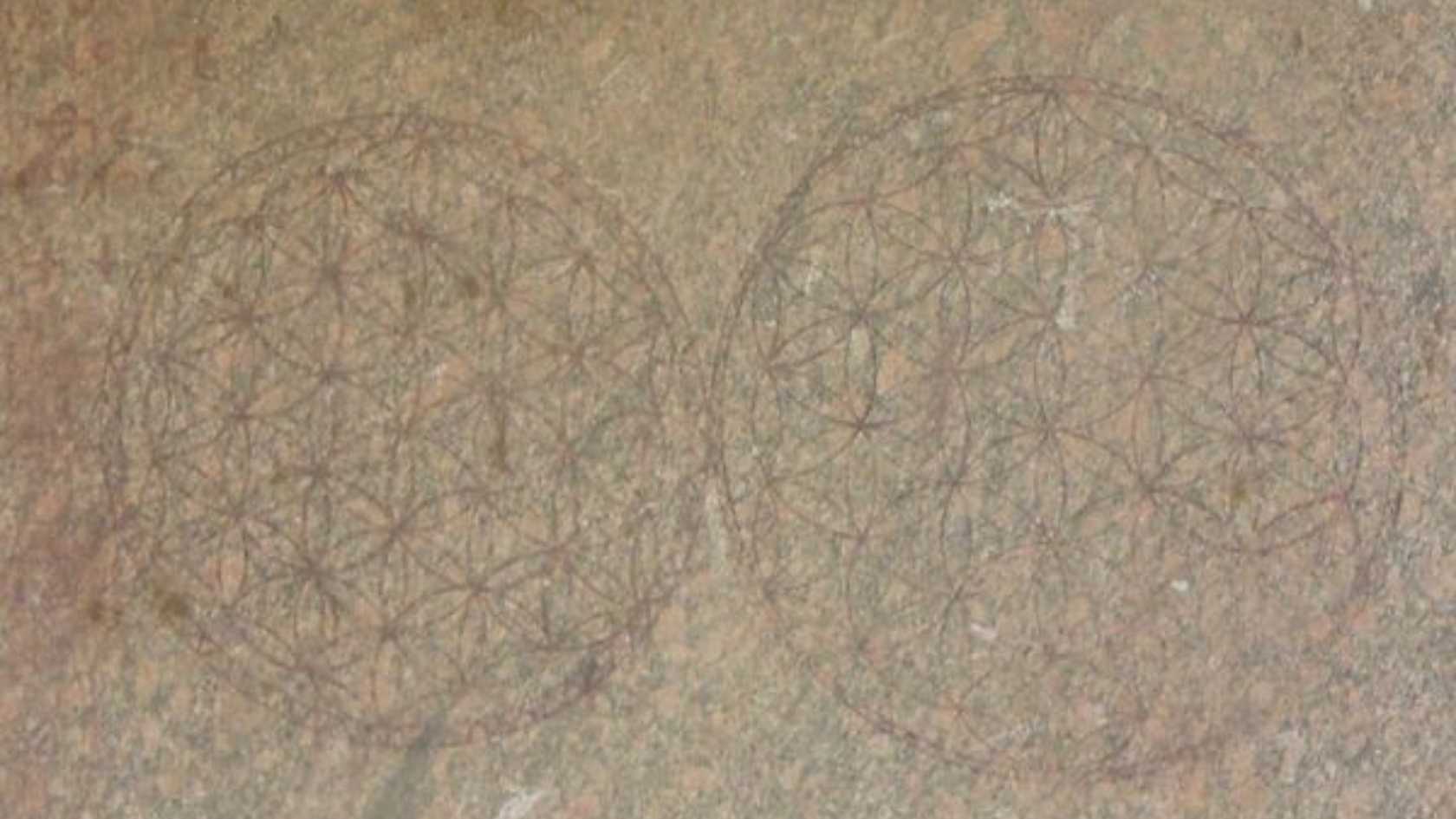
What makes the Abydos inscriptions so remarkable is the manner of their creation. Unlike the carved relief inscriptions that cover the walls of Egyptian temples — images and hieroglyphs chiselled deeply into stone — the Flower of Life at Abydos appears to have been drawn in red ochre, the same iron-rich pigment used by ancient artists for tens of thousands of years. The marks sit on the surface of the granite rather than being carved into it. This raises fascinating questions about provenance and purpose. Did someone draw this pattern on already-ancient stone, adding a symbol of geometric meaning to a site that already carried enormous sacred significance? Or does the informal surface application suggest a practitioner quietly recording a teaching in a space considered powerful enough to sanctify that act? The precision of the circles — which appear to have been drawn with a fixed compass or equivalent instrument — indicates a trained geometer, someone who understood the construction method thoroughly and executed it deliberately.
The Temple of Osiris was the cult centre for one of Egypt's most important deities — the god of death, resurrection, and the afterlife. Osiris was the first mummified king, the prototype for all subsequent pharaonic rebirth, and his temple at Abydos was considered so sacred that wealthy Egyptians across all periods aspired to have their mummies transported there, or at least a commemorative stela erected in its precincts. To find the Flower of Life within this space is deeply significant. The symbol of geometric completeness and regenerative potential appears within the temple of the god who embodies regeneration itself.
Beyond Abydos, the Flower of Life or closely related patterns appear across the ancient world with striking consistency. In the Assyrian palace reliefs of ancient Mesopotamia, circular rosette patterns sharing the Flower of Life's fundamental geometry decorate the clothing of kings and the borders of sacred images. In ancient India, similar patterns appear in temple architecture, floor tiles, and the geometric diagrams (yantras) used in Hindu and Buddhist meditation. In ancient China, the pattern has been found beneath the paw of the bronze lions that guard the entrance to the Forbidden City in Beijing — a placement charged with symbolism, since the lion's paw resting on a sphere is a traditional image of wisdom holding the world in complete understanding. The Flower of Life as the object beneath the lion's paw: knowledge of the world's deep geometric structure, held in readiness, available to those who know where to look.
The pattern also appears in the Louvre's collections, in ancient Celtic knotwork where the underlying geometry of overlapping circles is visible in the construction grid, in Islamic geometric art where the hexagonal tessellation that the Flower of Life generates is a central motif, and in the Gothic rose windows of medieval European cathedrals that encode Flower of Life geometry in their radial designs. Each cultural tradition discovered or inherited this pattern independently, or perhaps transmitted it along the trade routes and pilgrimage paths that connected the ancient world more thoroughly than we sometimes remember. In either case, the pattern's persistence across cultures and millennia indicates it is not merely a decorative convention but something that recurs because it reflects a real geometric truth — one that trained eyes recognise regardless of the cultural vocabulary available to them.
Leonardo da Vinci
Among the historical figures who engaged seriously with the Flower of Life, Leonardo da Vinci occupies a particularly significant position. Leonardo's notebooks — those extraordinary repositories of artistic, scientific, and philosophical investigation — contain drawings and studies of the Flower of Life pattern and careful analyses of its mathematical properties. This was not casual doodling. Leonardo approached geometry with the same systematic rigour he brought to anatomy, hydraulics, and aerodynamics. His interest in the Flower of Life was part of a broader investigation into the mathematical principles underlying natural form — the same investigation that led him to study the golden ratio in the proportions of the human body, the branching patterns of trees, and the spiral geometry of shells and water in motion.
Leonardo was working in the tradition of Renaissance Neoplatonism, which held that mathematical forms were the truest expressions of divine intelligence and that understanding geometry was, in a very real sense, understanding the mind of the Creator. His friend and collaborator Luca Pacioli, a Franciscan friar and mathematician, wrote the famous treatise De Divina Proportione (1509), illustrated with drawings by Leonardo himself, which explored the golden ratio and its appearance in the five regular polyhedra. The Flower of Life fits naturally into this intellectual project: if the golden ratio encoded divine proportion in one dimension and the Platonic Solids encoded divine form in three dimensions, the Flower of Life encoded divine pattern in two dimensions — the template from which the higher-dimensional forms could be derived. Leonardo and Pacioli were not merely drawing beautiful shapes; they were trying to read the geometric language in which they believed God had written the cosmos.
What Leonardo specifically noted in his geometric studies was the way the Flower of Life generates both the triangular and hexagonal grids simultaneously. The centres of the circles in the Flower of Life fall on a triangular grid; the spaces between them form hexagons. The same diagram, depending on how you attend to it — whether you connect the centres or trace the interstices — yields two different but equally important geometric structures. This duality, the capacity of a single pattern to encode multiple geometric perspectives simultaneously, was precisely what appealed to Leonardo's multidisciplinary mind. He saw in the Flower of Life what he saw in the human body: a unified design that simultaneously encodes multiple systems, each complete in itself, each embedded within the others.
The geometric analyses that Leonardo and his contemporaries performed on the Flower of Life were later developed in the twentieth century, most extensively by Drunvalo Melchizedek, whose two-volume work The Ancient Secret of the Flower of Life brought the symbol to widespread contemporary awareness. Melchizedek's teaching positions the Flower of Life as what he terms the energetic blueprint underlying all physical reality — the template from which the universe constructs itself at every scale, from the subatomic to the galactic. His work drew on ancient sources, esoteric traditions, and scientific observation to argue that the pattern is not merely a beautiful design but the actual geometric structure of the vacuum from which physical matter emerges.
The Geometry of Six
The Flower of Life is built on the geometry of six, and understanding why is to grasp one of the deepest and most productive facts in all of two-dimensional mathematics. Six equal circles fit perfectly around one equal circle — not approximately, not with a residual gap or overlap, but precisely and exactly. This is not a numerical coincidence but a necessary geometric truth arising from the equilateral triangle. When you try to wrap circles of the same radius around a central circle, each tangent touching circle subtends exactly 60 degrees at the centre of the central circle (because the centres of the touching circles and the centre of the central circle form equilateral triangles, whose internal angles are 60°). Since 360 ÷ 60 = 6, exactly six circles fit — no more, no less. The equilateral triangle, the circle, and the number six are bound together in a relationship of absolute geometric necessity, and the Flower of Life is the two-dimensional diagram that makes that necessity visible. The hexagonal tessellation that results — and the mathematics of why only three regular polygons can tile the plane — is explored in the Guide to Geometry: Tessellations.
This necessity has consequences that ripple through the natural world at every scale. The honeybee has not read any books on geometry, but it builds its comb in hexagonal cells because the regular hexagon is the most efficient way to divide a plane into equal areas with minimum total wall length — a fact mathematically proved only in 1999 (the Honeycomb Conjecture, proven by Thomas Hales), though bees have known it by evolutionary instinct for tens of millions of years. The hexagonal arrangement that bees arrive at is precisely the arrangement visible in the Flower of Life: six cells around one, the same configuration, just rendered in wax rather than ink.
When volcanic basalt cools and contracts, the same geometric optimisation operates at the molecular level: the contracting rock minimises internal stress by cracking along hexagonal lines, which is why the Giant's Causeway in Northern Ireland and columnar basalt formations found on every volcanic island display their characteristic regular hexagonal columns. The Flower of Life is literally written into the geological record.

Water, when it crystallises into ice and forms snow, creates hexagonal structures because the bonding angle of water molecules (approximately 104.5°) drives the formation of hexagonal rings in the solid phase. Every snowflake is a unique elaboration on a hexagonal template — and that template is the same one visible in the Flower of Life. Carbon atoms, when arranged in a flat sheet (graphene), form a hexagonal lattice. Benzene (C₆H₆), the foundational molecule of organic chemistry and the structural basis of all aromatic compounds including DNA's bases, is a six-membered carbon ring. The eyes of insects are compound structures of hexagonal lenses packed in the Flower of Life configuration. The skin of many fish and the scales of reptiles tile in hexagonal or near-hexagonal patterns. The hexagonal patterning visible in the Flower of Life is not a symbol imposed on nature by human imagination but a geometric truth that nature expresses wherever equal elements, uniform forces, and the pressure toward efficiency combine.
The reason the Flower of Life produces hexagonal rather than pentagonal or octagonal structure is that the equilateral triangle is the polygon that allows exact angle-filling in two dimensions. Three equilateral triangles meeting at a point sum to 180°, which is flat; four sum to 240°, which curves into three dimensions (and is the basis of the tetrahedron); six sum to exactly 360°, which tiles the plane with no gaps and no overlaps. The hexagon, as a regular polygon composed of six equilateral triangles sharing a centre, is the natural consequence of this arithmetic of angles. The Flower of Life encodes this arithmetic in its most visible, most immediately comprehensible form — not as an abstract equation but as a diagram anyone can draw with a compass in a few minutes, that anyone can see is both beautifully simple and structurally inexhaustible.
Stages of Expansion
The Flower of Life as typically depicted consists of nineteen circles arranged in a hexagonal pattern around a central circle, with a surrounding boundary circle that clips the outermost rings to show only the portions that fall within a neat circular enclosure. But the Flower of Life is not a static, finished object — it is one stage in an ongoing process of expansion. When we continue placing circles following the same rule — each new circle centred on an intersection point, its circumference passing through the centres of its neighbours — the pattern grows outward ring by ring, each new stage revealing more of the underlying geometry. The nineteen-circle Flower of Life is the first flowering, but it is not the last.
The next stage of expansion beyond the nineteen circles produces what we call the Moonflower — a pattern of thirty-seven circles. The Moonflower adds another complete ring to the Flower of Life, and in doing so reveals new geometric relationships that were latent but invisible in the smaller pattern. The transition from Flower to Moonflower is analogous — as our Atomic Geometry research proposes — to moving from one electron shell to the next in atomic structure. More energy, more space, more capacity for differentiated form.
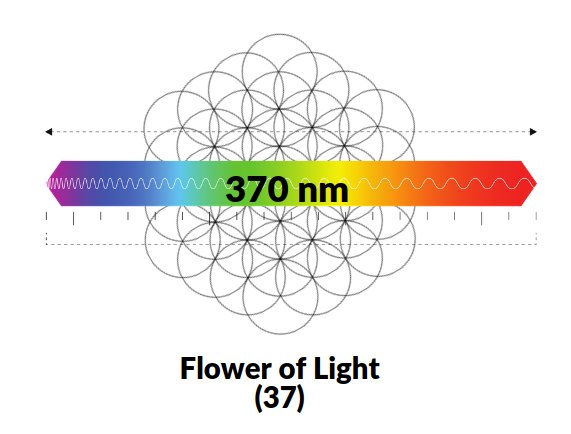
The following stage — sixty-one circles — is called the Flower of Heaven. Here the pattern has expanded to three complete rings beyond the central circle, and the geometric information encoded has grown correspondingly richer. The numbers themselves — 1, 7, 19, 37, 61 — follow a precise numerical pattern: each new ring adds the next multiple of six (6, 12, 18, 24...), reflecting the hexagonal symmetry of the underlying geometry. These are the centred hexagonal numbers, a sequence with deep roots in number theory and combinatorics. Crucially, this sequence also describes the way electrons fill the orbital shells of atoms: the first shell holds 2 electrons (1 orbital), the second holds 8 (4 orbitals), the third holds 18 (9 orbitals), and so on — numbers that arise from the same hexagonal counting logic. The geometry of the expanding Flower and the geometry of the expanding atom are, our research proposes, the same geometry expressed at different scales.
Each stage of expansion also reveals a new layer of the relationship between circles and the tessellations they generate. At nineteen circles, the Flower of Life clearly shows both the triangular and hexagonal grids embedded in the intersection pattern. At thirty-seven circles, the Star of David (hexagram) patterns become more prominent. At sixty-one circles, the complexity is sufficient to reveal connections between the Flower of Life geometry and the three-dimensional forms — the Platonic Solids — that can be derived from its subsets. The Flower of Heaven is not merely a larger version of the Flower of Life; it is a different geometric conversation, one that has moved from the vocabulary to the grammar of sacred geometry.
Atomic Structure
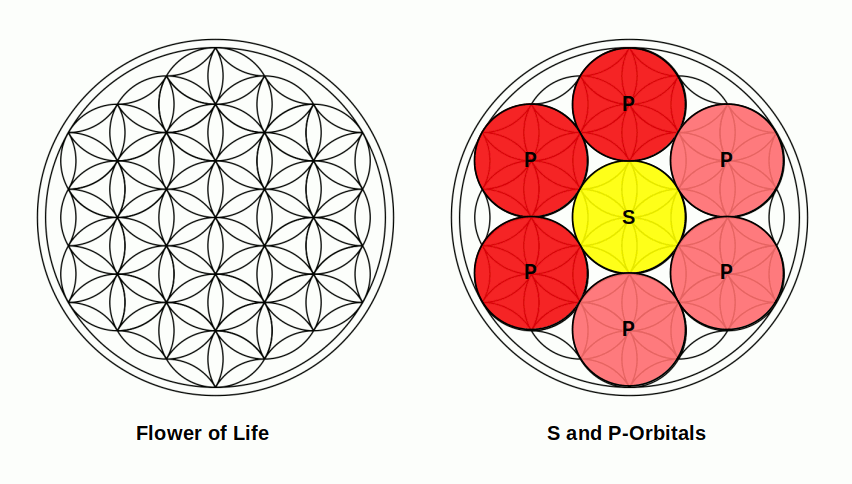
One of the most remarkable discoveries associated with the Flower of Life — and one that anchors the symbol firmly in contemporary scientific understanding rather than confining it to ancient mysticism — is its precise correspondence with the structure of the electron cloud surrounding an atomic nucleus. The S and P orbitals, which define the electron probability distribution around atoms in the first and second rows of the periodic table, map directly onto the geometry of the Flower of Life. This is not a loose visual resemblance but a precise geometric correspondence that can be measured, verified, and traced through the mathematics of quantum mechanics.
The S orbital is spherical — a sphere of probability density surrounding the nucleus, corresponding in two-dimensional cross-section to a circle. When this circle is positioned at the centre of the Flower of Life, its relationship to the surrounding P orbitals becomes immediately visible. The P orbitals are dumbbell-shaped in three dimensions (two lobes oriented along a single axis), and there are three of them, oriented along the three perpendicular spatial axes (x, y, z). When these orbital lobes are projected onto the plane of the Flower of Life, they align precisely with the overlapping circles of the pattern. The intersection regions — the vesica shapes formed where adjacent circles overlap — correspond to the regions of maximum electron probability in the P orbitals. The nodes (regions of zero probability) correspond to the spaces between the circles.
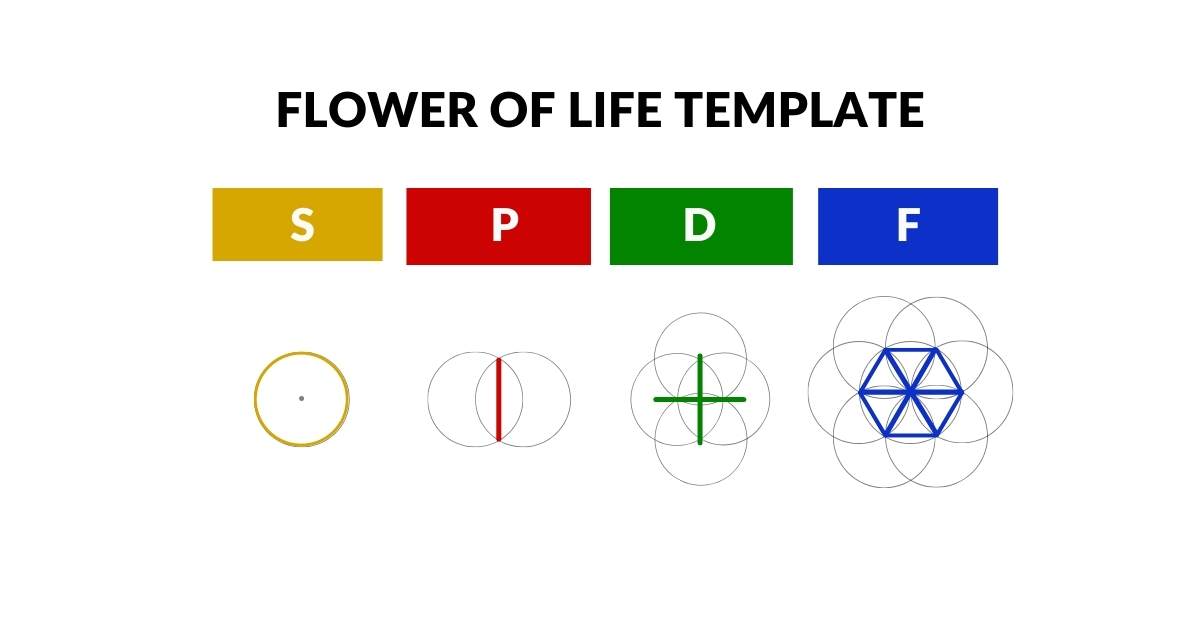
This correspondence between the Flower of Life and orbital geometry is central to our Atomic Geometry research, which proposes that electron orbitals can be understood as geometric forms rather than merely statistical distributions. In this view, the Flower of Life is not a symbol that happens to resemble orbital diagrams — it is the actual geometric template from which the orbital structure arises, the two-dimensional projection of a three-dimensional geometric reality that operates at the quantum scale. The S orbital is the central circle; the three P orbitals are the first ring of six circles (arranged in three pairs along the three spatial axes); the subsequent D and F orbitals correspond to the further rings of the expanding pattern. The entire periodic table, in this interpretation, is a chart of which stage of Flower of Life expansion each element has reached.
If this geometric interpretation of atomic structure is correct — and the correspondences are precise enough to take seriously as a research programme — then the ancient geometers who inscribed the Flower of Life onto temple walls were encoding, whether consciously or through inspired geometric intuition, the actual structure of matter. The diagram that describes how circles most efficiently fill a plane also describes how electrons most efficiently fill the space around a nucleus. The geometry of the honeycomb and the snowflake is also the geometry of the atom. The Flower of Life as an energetic blueprint is not, in this reading, a mystical claim but a scientific one: the pattern describes a real structural constraint that operates at every scale, from the subatomic to the cosmological, because space itself has a geometry, and that geometry is hexagonal.
Energetic Blueprint
The concept of the Flower of Life as the energetic blueprint of reality — a template that underlies and generates physical form — is ancient in its roots but has received its most systematic modern articulation through the work of Drunvalo Melchizedek. His teaching draws on a wide range of sources: the ancient Egyptian mystery school tradition as he received it, the Kabbalistic understanding of creation as a geometric emanation from a divine source, the Hermetic principle that the universe is constructed according to mathematical laws accessible to the prepared human mind. The Flower of Life, in this teaching, is the first pattern that emerges from the act of creation — the first moment at which the formless void organises itself into discernible structure — and every subsequent form arises from it by a process of geometric necessity.
This idea resonates deeply with multiple philosophical traditions. In the Kabbalistic tradition, the act of creation is described as a process of emanation — the infinite divine source (Ein Sof) projecting itself into a series of increasingly defined forms, each a further specification of the one before. The Sephiroth on the Tree of Life represent major stages of this emanation, each a different quality of divine energy taking form in the created world. The geometry of the Flower of Life, with its rings of circles each arising from the intersections of the previous ring, mirrors this emanative structure with striking precision: each ring is a new level of specification, a new set of distinctions drawn within the undifferentiated wholeness of the circle, just as each Sephira is a new quality of being drawn from the infinite.
In Neoplatonic philosophy, as articulated by Plotinus and his successors, the universe proceeds from the One through a series of intermediate principles — Nous (Intellect) and Psyche (Soul) — before reaching the material world. Each level is a more defined, more particularised version of the one above it, and each can be understood as a geometric stage of progressive specification: from the dimensionless point (the One) through the line (Intellect drawing its first distinction) through the plane (Soul, the realm of two-dimensional archetypal forms) to three-dimensional material space. The Flower of Life, as the archetypal two-dimensional pattern from which all plane-filling forms arise, occupies exactly the position of Platonic archetypes in this scheme.
Modern physics offers its own language for understanding the blueprint concept. The quantum vacuum — the ground state of space from which particles arise through quantum fluctuations — is not empty in any simple sense. It teems with virtual particles, zero-point energy, and structured quantum fields. Physicists and mathematicians have proposed various models for the geometric organisation of this vacuum at the Planck scale, and some proposals describe a space-filling, highly symmetric structure consonant with the kind of ordered geometry that the Flower of Life exemplifies. Whether or not the Flower of Life literally describes Planck-scale vacuum structure, the underlying principle — that apparent emptiness has geometric organisation, and that observable physical forms arise by instantiating that organisation at larger scales — is now a mainstream scientific insight.
The Tree of Life
The Etz Chaim — the Tree of Life — is the central diagram of Kabbalistic mysticism, the primary map of the divine structure of existence in the Jewish esoteric tradition and the Western mystery schools that drew on it. Its ten Sephiroth (singular: Sephira), meaning "emanations" or "attributes," represent the ten qualities through which the infinite divine source — Ein Sof, the limitless — projects itself into the finite world of creation. Connected by twenty-two paths (corresponding to the twenty-two letters of the Hebrew alphabet) and arranged on three vertical pillars — the Pillar of Severity on the left, the Pillar of Mercy on the right, and the Pillar of Equilibrium in the centre — the Tree of Life describes the entire arc of divine creation and the entire path of mystical return. From Kether (Crown) at the summit — the first, most refined emanation, closest to the undifferentiated source — the lightning bolt of creation descends through Chokhmah (Wisdom), Binah (Understanding), Chesed (Loving-kindness), Geburah (Strength), Tiphareth (Beauty), Netzach (Victory), Hod (Splendour), Yesod (Foundation), and finally Malkuth (Kingdom) at the base — the most material Sephira, the one closest to the physical world of experience, the ground in which all the higher emanations are rooted and through which they become perceptible.
The discovery that the Tree of Life can be derived from the Flower of Life — that the ten Sephiroth and their twenty-two connecting paths correspond precisely to specific intersection points and connecting lines within the Flower of Life pattern — was one of the most significant findings in modern sacred geometry research. Drunvalo Melchizedek, working with the Flower of Life tradition as he received it from his teachers, demonstrated that when the Flower of Life is drawn and specific nodes are selected and connected, the Tree of Life emerges from the pattern with geometric exactness. The ten Sephiroth correspond to ten specific intersection points within the Flower of Life; the twenty-two paths between them follow the lines of the underlying circle geometry. This means the Tree of Life is not an independent diagram invented by Kabbalistic sages in isolation from other sacred traditions; it is a selective reading of the more fundamental Flower of Life pattern, a specific set of nodes and connections extracted from the universal geometric template.
This derivation has profound theological and philosophical implications. The Kabbalistic concept of Ein Sof — the limitless, the boundless, the state before any differentiation or creation — corresponds in the geometric framework to the unbounded potential of the Flower of Life before any particular form is selected from it. Ein Sof is the field of all possible circles, all possible intersection points, all possible connections — pure potential without specification. The moment creation begins — the moment the Kabbalistic tradition describes as the Tzimtzum, the divine self-contraction that creates the space for the world — corresponds to the moment when specific nodes are chosen from the Flower of Life and specific connections are made. Creation is the act of selecting from the infinite. The Tree of Life is one such selection — one particular order of emanation, one specific path of descent from the limitless source into the finite world, encoded in the geometry of the Flower of Life as one melody is encoded within the full range of sound.
The Tree of Life was transmitted from the Jewish Kabbalistic tradition into the broader Western esoteric tradition through the Hermetic Qabalah — a syncretic tradition that blended Kabbalistic structure with Neoplatonic philosophy, Hermeticism, and later with Renaissance magic, Rosicrucianism, and Freemasonry. The Hermetic Qabalah became the backbone of the Western mystery school tradition from the Renaissance onward, and through it the Tree of Life became the central organising principle for a vast range of esoteric practices and teachings. The Golden Dawn system of ceremonial magic in the late nineteenth century mapped the Tarot's Major Arcana onto the twenty-two paths of the Tree, the Minor Arcana onto the ten Sephiroth, and the entire system of magical practice onto the Tree's structure. In all of these traditions, the Tree of Life is the map of consciousness and cosmos — and in our understanding, it is the map that was always already present in the Flower of Life, waiting to be read by eyes that knew where to look.
In the next chapter, we explore The Fruit of Life & Metatron's Cube — the thirteen circles that, when fully connected, reveal the five Platonic Solids hidden within the Flower of Life.
FAQ
What is the Flower of Life?
The Flower of Life is a pattern of nineteen overlapping circles arranged in hexagonal formation within a boundary circle. It is the central symbol of sacred geometry — a geometric generating engine from which every major form in the tradition (the Platonic solids, Metatron's Cube, the Tree of Life) can be derived. It appears in ancient temples, Renaissance notebooks, and the molecular structure of matter.
Why does the Flower of Life appear so often in nature?
The pattern is built on the geometry of six — exactly six equal circles fit around one (because equilateral triangles subtend 60° and 360 ÷ 60 = 6). This hexagonal geometry appears wherever nature optimises for efficiency: honeycomb cells, basalt columns, snowflakes, graphene, benzene rings, and insect compound eyes all express the same six-fold structure.
Where has the Flower of Life been found in the ancient world?
The most famous examples are at the Temple of Osiris at Abydos in Egypt (drawn in red ochre on granite, c. 1300 BCE or earlier), beneath the paw of bronze lions at Beijing's Forbidden City, in Assyrian palace reliefs, in ancient Indian temple architecture, and in Leonardo da Vinci's notebooks. It also appears embedded in Gothic rose windows and Islamic geometric tilework.
How does the Flower of Life relate to atomic structure?
The S and P electron orbitals map directly onto the Flower of Life's geometry: the central S orbital corresponds to the central circle, the three P orbital pairs align with the first ring of six circles. D and F orbitals correspond to subsequent rings. Our Atomic Geometry research proposes that the Flower of Life is the actual geometric template from which orbital structure arises.