Introduction
Traditional mathematics views numbers from the perspective of a one-dimensional number line — a straight, uniform object with whole numbers stepping out in both directions from zero. This picture is useful, but it conceals something fundamental.
When numbers are subjected to infinite recursive operations — dividing endlessly, or taking successive square roots — the number line turns out to be far from uniform. Certain numbers act as attractors: fixed points that infinite processes converge towards but never cross. These fixed points generate infinite boundaries — thresholds where a process runs forever without ever passing through. Infinity is not just at the ends of the number line. It is woven through its interior.
Geometric Maths identifies exactly eight such infinite boundaries. Recognising where they sit, and what generates them, transforms the number line from a one-dimensional ruler into a closed geometric object: a square. That square is not merely a visual metaphor. It carries real consequences for prime number theory, for the foundations of imaginary numbers, and for the Continuum Hypothesis.
Key Takeaways
- Zero is not "nothing" — infinite division approaches it from both sides but never crosses it
- One is a second infinite boundary — infinite square roots converge to it from both directions
- The region between zero and one (Reciprocal Number Space) contains all prime numbers
- There are exactly 8 distinct types of infinity on the number line
- Folding the number line at its 8 boundaries produces a closed square — the geometric foundation of the framework
- Imaginary numbers are not a separate axis — they are rotations within the number square
The Nature of Zero
Mathematics is built on four operators: addition, subtraction, multiplication, and division. Each has unique properties, but division is the most revealing when it comes to the structure of the number line.
Take any positive number and keep dividing it in half: 1 → 0.5 → 0.25 → 0.125 → 0.0625 … The sequence never reaches zero. No matter how many times you halve, the result remains above zero. You can continue this process indefinitely — an infinite number of steps — and zero is still not reached. Yet the sequence converges unmistakably towards zero. The same process applies from the negative side: negative numbers, divided repeatedly, approach zero from below without ever crossing it.
This means zero is not simply the absence of quantity. It is an infinite boundary — a point that infinite division approaches from both sides but never reaches.


The Boundary of One
The same logic applies to the number one, but through a different operation: the square root.
Take any number greater than one and apply the square root repeatedly: 4 → 2 → 1.414 → 1.189 → 1.091 → 1.044 … The sequence descends towards one, converging without ever arriving. Now start below one: 0.25 → 0.5 → 0.707 → 0.841 → 0.917 … The sequence climbs towards one from below, again without ever reaching it.
One is therefore an infinite boundary for the square root function — approached from both sides but never crossed. Combined with zero, this means the number line has two special numbers that no ordinary arithmetic can reach in a finite number of steps. Every other number can be reached from every other number by a finite sequence of standard operations. Zero and one cannot. They are in a different category.


Reciprocal Number Space
The region between zero and one is not empty — it contains the reciprocal of every whole number that exists.
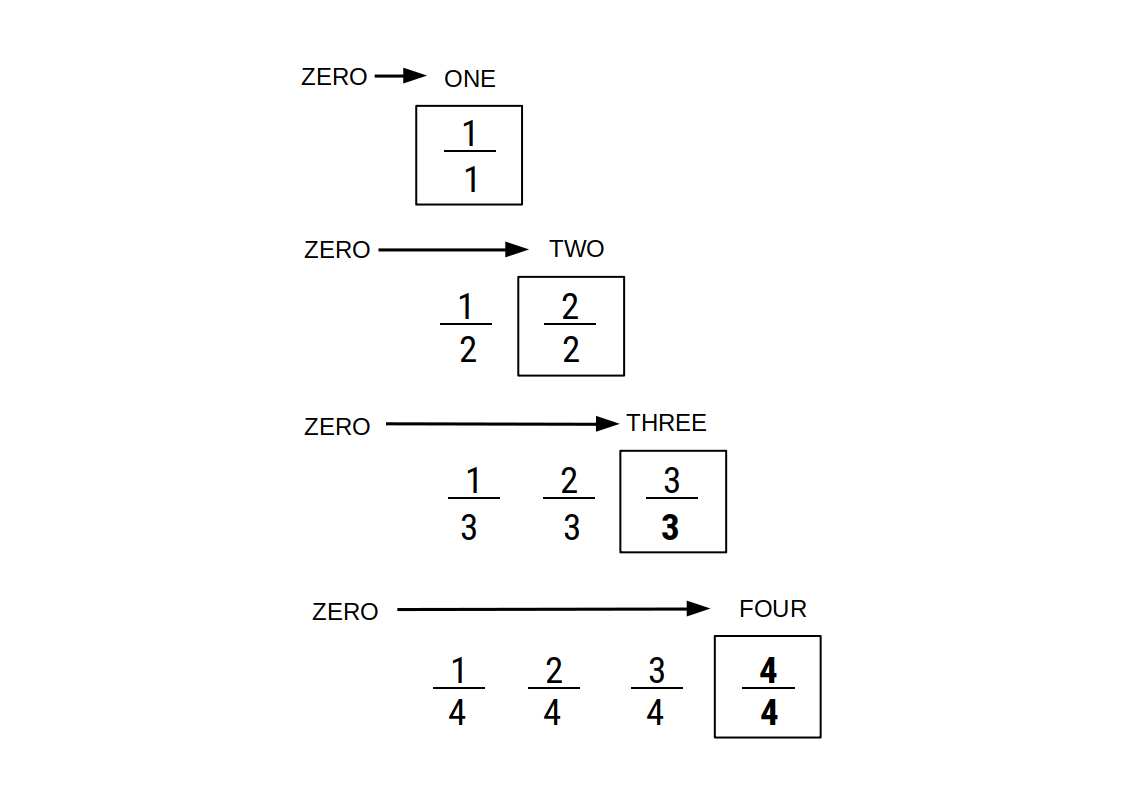
Draw a line of unit length. Divide it in half and you have 0.5 — the reciprocal of 2. Divide it into thirds and you have 0.333… — the reciprocal of 3. Into quarters: 0.25, the reciprocal of 4. This process can be continued indefinitely, generating the reciprocal of any whole number by a single act of division. The space between zero and one, therefore, contains an image of the entire infinite number line — compressed but complete.


This region — between zero and one — is called Reciprocal Number Space. Zero and one are not contained within it; they define its boundaries. This makes them a distinct class of number: not whole, not fractional, but the boundary conditions from which all other numbers emerge.
Notice also that as any whole number grows larger, its reciprocal grows smaller — approaching zero. The reciprocal of 1,000 is 0.001; of 1,000,000 is 0.000001. ZERO is therefore the mirror of infinity: the boundary that the reciprocal of an infinitely large number approaches but never reaches.
See Reciprocal Number Space for the full treatment.
8 Infinities on the Number Line
By examining zero and one as infinite boundaries, we can map the complete structure of infinity on the number line. There are exactly eight distinct infinite boundaries:
Around ZERO — approached from both sides by infinite division: - Boundary 1: positive numbers converging to zero from above - Boundary 2: negative numbers converging to zero from below
Around +ONE — approached from both sides by infinite square root: - Boundary 3: numbers greater than one converging downward to one - Boundary 4: numbers between zero and one converging upward to one
Around −ONE — the mirror of +ONE in the negative domain: - Boundary 5: numbers between −1 and 0 converging toward −ONE - Boundary 6: numbers less than −1 converging toward −ONE
The two infinite expansions: - Boundary 7: positive whole numbers extending to +∞ - Boundary 8: negative whole numbers extending to −∞
These eight boundaries divide the number line into four qualitatively distinct sections: positive whole numbers, positive reciprocal numbers, negative reciprocal numbers, and negative whole numbers. ZERO and ±ONE do not belong to any of these sections — they are the walls between them.


Watch: 8 Infinities on the Number Line
For the full derivation see 8 Infinities on the Number Line.
The Number Square
Here is where geometry enters directly.
If the number line has four distinct sections, each bounded on both sides by infinite boundaries, then these sections can be folded at their boundary points. When this is done, they form a closed square:
- Positive and negative whole number space become two opposite sides
- Positive and negative reciprocal space become the other two opposite sides
- ZERO sits at one corner, +ONE and −ONE at the two adjacent corners, and infinity — where the two whole-number expansions meet — at the fourth corner


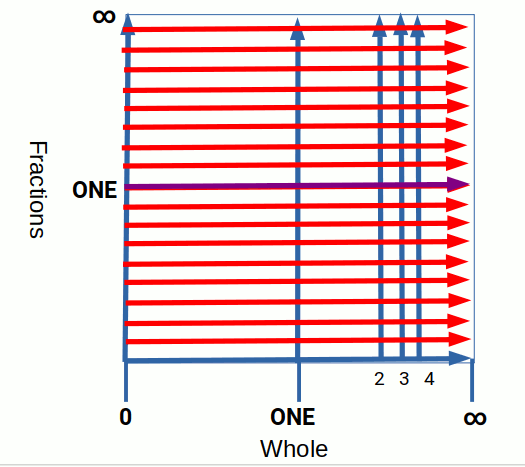
This is the foundational insight of Geometric Maths: the number line is not a line — it is a square. The traditional number line is an unfolded version of a closed geometric object, and treating it as a square unlocks properties that the line alone cannot show.
Reciprocal Prime Numbers
Because Reciprocal Number Space contains all prime numbers, zero and one are confirmed as boundary precursors to all primes. Plotting the reciprocals of primes geometrically reveals a distinct structure.
The number 2 is the only even prime, and its reciprocal divides the unit line exactly in half. Each subsequent prime is odd and produces a unique division point — a midsection that has never appeared in any previous division. Connecting these unique midsection points produces a smooth arc from 0.5 down towards zero: the reciprocal prime number curve.


This geometric view also provides a new definition of primeness: a prime is any whole number whose reciprocal generates a division point that is unique relative to all numbers that precede it. This reframes primeness as a geometric property of reciprocal space — and offers a visual intuition for why primes become rarer as numbers grow: the remaining unique division points are increasingly confined to a small region near zero.
See Reciprocal Prime Numbers for the full derivation.
Imaginary Numbers and the Square
The implications of the number square extend to one of the most puzzling concepts in mathematics: imaginary numbers.
Standard mathematics introduces the imaginary unit i to handle √−1, which has no solution on the real number line. This leads to the complex number plane — a two-dimensional space perpendicular to the real axis. The construction works, but it requires adding a whole new dimension to accommodate a single edge case.
The number square offers a different perspective. Within the square, negative ONE is not across a conceptual gap from positive ONE — it is diagonally opposite in the same closed figure. Moving from ONE to −ONE around the square passes through two 90° corners. This is precisely what multiplication by i does in the complex plane: it rotates a number by 90°. Apply it twice and you get −1: i × i = −1.


The 'imaginary' dimension is not separate from the real number line — it emerges from the rotational geometry of the square.
Beyond the Number i
The imaginary unit i was introduced as a one-off fix for a single problem: √−1 has no solution on the real number line. But if i is actually a 90° rotation within the number square, then it is not a special case — it is the first example of a broader class of geometric root relationships.
Consider √2. Its value (≈1.414) sits between ONE and TWO on the number line, and it cannot be expressed as a fraction — it is irrational. But more than that, it represents a specific geometric relationship: the diagonal of a unit square. Similarly, √3 is the diagonal of a unit equilateral triangle. These are not just numbers — they are geometric operations that describe how space transforms.
The standard number line treats i, √2, √3, and all other root relationships as if they were the same kind of object. Geometric Maths proposes they are not. Each represents a distinct geometric transformation, and the current framework — which places them all on a single axis — does not have the vocabulary to distinguish them. A fuller treatment of numerical space would account for each of these root relationships on its own geometric terms.
This is one of the active frontiers of Geometric Maths — and it suggests that the complex number plane, as currently defined, is only a partial description of a richer geometric structure.
The Continuum Hypothesis
The four sections of the number square carry a direct implication for one of the most famous unresolved problems in mathematics.
Georg Cantor showed that the set of whole numbers (Aleph 0) is smaller than the set of all real numbers (Aleph 1). He then asked: is there an intermediate infinity — a set strictly larger than Aleph 0 but smaller than Aleph 1? This was shown to be formally undecidable in standard set theory.
Geometric Maths proposes an answer. The positive reciprocal section of the number square — all numbers between ZERO and ONE — forms a set called Aleph 0.5: larger than the countable integers, but bounded within a single unit interval. The square geometry makes this intermediate set visible as a distinct geometric section rather than a philosophical puzzle.
See Aleph 0.5 and 8 Infinities on the Number Line for the full argument.
Conclusion
Geometric Maths begins with a simple observation — that infinite processes reveal hidden structure in the number line — and follows it to a striking conclusion: the number line is not a line, but a square.
The key results:
- Zero is an infinite boundary — approached by infinite division from both sides but never reached
- One is a second infinite boundary — approached by infinite square roots from both sides
- Reciprocal Number Space (between zero and one) contains all prime numbers
- There are exactly 8 distinct types of infinity on the number line
- The four sections of the number line fold into a closed square
- Imaginary numbers are rotations within that square — not a separate dimension
- The intermediate infinity between countable and continuous sets (Aleph 0.5) is a visible geometric section of the square
None of these results require new mathematics to be invented. They follow from taking the behaviour of infinite processes seriously and asking what shape the number line actually is. The answer — a square — was always there. It just needed to be seen.
For the full axiomatic treatment see Geometric Maths — Axioms and Definitions.
FAQ
What is Geometric Maths?
Geometric Maths is a new framework that interprets numbers not only along a 1D number line but across higher-dimensional space. It redefines the axioms of mathematics to reveal properties of zero, one, infinity, and prime numbers that conventional theory cannot express.
How many types of infinity are there on the number line?
Geometric Maths identifies 8 distinct types of infinity — two boundary infinities surrounding zero, four surrounding ±one (approaching from both sides), and the two infinite expansions of positive and negative whole numbers. Note that the number 8 and the infinity symbol ∞ share the same shape, rotated 90°.
What is Reciprocal Number Space?
Reciprocal Number Space is the region between zero and one on the number line. It contains the reciprocals of all whole numbers — including all prime numbers. Zero and one sit at its boundaries and are treated as a special class of number separate from all others.
What is the Number Square?
When the four sections of the number line are folded at their infinite boundary points, they form a closed square. Zero occupies one corner, +ONE and −ONE the two adjacent corners, and infinity the fourth. This is not a visual metaphor — it is a geometric consequence of the eight infinite boundaries, and it provides a natural home for imaginary numbers as rotations rather than a separate axis.
How does Geometric Maths treat imaginary numbers?
Rather than introducing a separate complex plane, Geometric Maths shows that the imaginary unit i corresponds to a 90° rotation within the number square. The four sections of the square map directly onto the four powers of i: 1, i, −1, −i. The 'imaginary' dimension is not separate from the real number line — it emerges from its square geometry.
What articles go deeper into these ideas?
See Reciprocal Number Space, Reciprocal Prime Numbers, 8 Infinities on the Number Line, and Geometric Maths — Axioms and Definitions for the full treatment.