Introduction
Throughout history, human cultures have developed elaborate symbolic systems for describing the nature of reality, the structure of creation, and the relationship between the individual and the cosmos. Examined separately, these systems appear as cultural artefacts — the product of particular times, places, and languages. Examined geometrically, they reveal a startling coherence: the same shapes, the same ratios, and the same structural progressions appear independently across traditions separated by thousands of years and thousands of miles.
Harmonic Philosophy is the study of this convergence. It does not reduce religious or philosophical traditions to mathematics, nor does it make theological claims about the truth of any particular belief. It observes that the symbolic and numerical architectures of these traditions encode geometric structures — and that these structures are the same ones that govern the atom, the musical scale, and the large-scale organisation of matter. The result is not a unified religion, but a unified geometry underlying many religions.
Key Takeaways
- Major philosophical and religious traditions independently encoded the same geometric structures in their creation narratives, symbolic systems, and sacred numbers
- The dot and circle — appearing as the Monad/Dyad, Yin-Yang, Purusha/Prakriti, [Big Bang](/did-big-bang-happen/) singularity, and the Biblical separation of light from dark — is the universal geometric symbol of creation
- The Five Elements (Fire, Water, Earth, Air, Aether) map precisely onto the five Platonic solids nested within the [Flower of Life](/ultimate-guide-to-sacred-geometry/flower-of-life/), with an updated assignment that matches modern scientific understanding
- Existential Dimensions — Hell/Underworld, Earth, Heaven, and Aether — correspond to distinct space-filling geometric structures that generate different types of spatial ordinance
- Harmonic Philosophy converges with Atomic Geometry and Harmonic Chemistry: the same geometric ratios that govern the atom and the periodic table also underlie the world's philosophical traditions
The Beginning of Creation: The Dot and the Circle

Across cultures and millennia, the most fundamental act of creation is described in identical geometric terms: a single, indivisible point that gives rise to a surrounding field. This pattern appears so consistently that it cannot be coincidental.
In Pythagorean cosmology, Euclid defined the point as that which has no part. This geometric object — the Monad — was held to be of divine nature. When the Monad divides, it creates the Dyad: two circles overlapping to form the Vesica Piscis, from which all geometric ratios can be derived without measurement. From this simple division, all numbers and all forms were believed to emerge.
The Chinese concept of the Dyad appears as the Yin and Yang symbol: two interpenetrating fields, each containing a dot of the opposite. The continuous motion this generates was understood as the mechanism of the Universe. The Biblical narrative of the first day of creation — God dividing light from dark — describes the same initial division of unity into polarity. In the Vedic knowledge of India, the masculine principle Purusha (pure consciousness) is the dot, immobile and all-observing, surrounded by Prakriti (matter and energy), which is always in motion — the circle.
In modern scientific terms, the Big Bang begins with a singularity — a point of infinite density — which expands into space. The parallel is precise: a dimensionless point gives rise to a surrounding volume. Wherever we look — from the nucleus of an atom surrounded by its electron cloud, to the black hole at the centre of a galaxy surrounded by spiral arms — the dot and circle appear at every scale of reality.
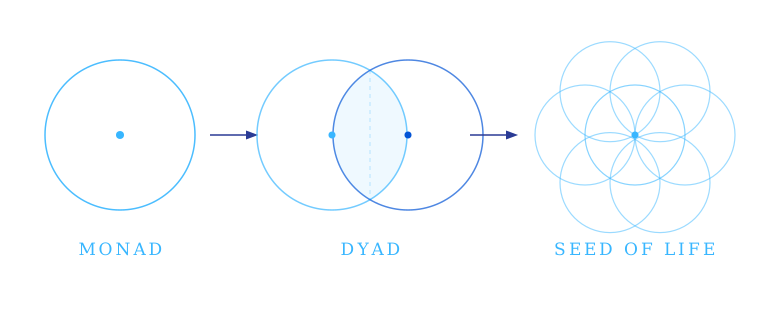
The relationship between the dot and circle is encoded in the number π (pi): the ratio of a circle's circumference to its diameter. Because of its transcendental nature, π has held a place of great significance in mathematics throughout history. The Monad — incorporating the dot, the circle, and π — was considered by the Ancient Greeks to be the object from which all creation proceeds.
The Flower of Life and Sacred Geometry
If the dot and circle represent the beginning of creation, the Flower of Life represents its unfolding. This pattern of overlapping circles, found on temple walls in Egypt, in Leonardo da Vinci's notebooks, and in sacred sites across cultures, encodes a precise geometric progression.
Starting from a single circle, the pattern expands by reflecting the initial circle across its circumference to produce two overlapping circles — the Vesica Piscis. Adding further reflections produces the Trinity (3 circles), the Trion Re (4), and the Seed of Life (7). The next layer generates the Egg of Life (13) and the Flower of Life (19). Continuing outwards produces the Flower of Light (37) and the Flower of Heaven (61), from which the Fruit of Life (13 full circles) emerges.
Connecting the centres of the 13 circles of the Fruit of Life generates Metatron's Cube — the geometric figure that contains, as shadow projections, all five Platonic solids. This is not merely a coincidence of form: the Platonic solids appear at specific stages within the progression, nested inside one another in a precise order that determines which solid contains which. The Octahedron nests inside the Star-Tetrahedron, which nests inside the Cube — all within the Flower of Life. The Dodecahedron and Icosahedron emerge from the outer ring.
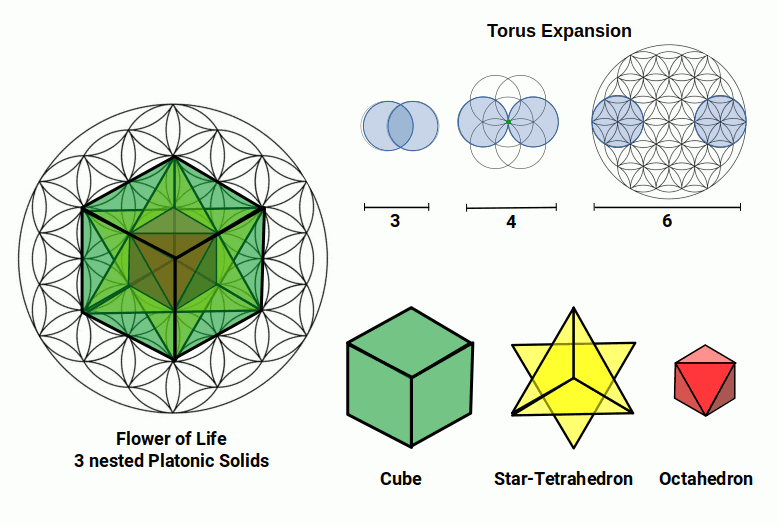
This nested structure divides the five Platonic solids into two groups: the Simple Solids (Octahedron, Star-Tetrahedron, Cube), which are related to musical ratios and constitute the System of Reality — the spatial framework of observable 3D existence — and the Higher Solids (Icosahedron and Dodecahedron), governed by the Golden Ratio (Φ) and constituting what the book calls the Ordinance of Reality, which organises the temporal aspects of experience.
The Five Elements Revisited
The doctrine of the Five Elements — Fire, Water, Earth, Air, and Aether — is one of the most widely distributed ideas in human intellectual history, appearing in Greek philosophy, Vedic cosmology, Chinese alchemy, and Buddhist metaphysics. Plato associated each element with one of the Platonic solids. However, his assignment — Tetrahedron = Fire, Octahedron = Air, Cube = Earth, Icosahedron = Water, Dodecahedron = Aether — was made without the benefit of modern chemistry, molecular science, or electromagnetic theory.
Harmonic Philosophy proposes a revised assignment based on the nested structure of the Platonic solids and their correspondence to physical phenomena:
| Element | Platonic Solid | Physical Correspondence |
|---|---|---|
| Fire | Octahedron | Combustion; the innermost sphere |
| Water | Tetrahedron | The water molecule (H₂O) is tetrahedral |
| Earth | Cube | Crystal lattice structures of solid compounds |
| Air | Dodecahedron | The atmosphere (~80% diatomic N₂), pentagonal faces |
| Aether | Icosahedron | Electromagnetic field; electricity |
This revised mapping resolves long-standing inconsistencies in the classical assignment. The Octahedron, as the innermost solid in the nested sequence, generates the Octahedral Space of the Fire dimension — the hottest, densest region below the Earth's crust. The Tetrahedron corresponds to Water not arbitrarily but because the water molecule itself is a tetrahedral structure. The Cube's unique property as the only Platonic solid that tiles space by itself makes it the natural geometry of the solid Earth dimension. The Icosahedron, with its rotatable midsection, corresponds to the electromagnetic atmosphere — Aether — just as the midsection of the Earth's electromagnetic field rotates with the planet.
Viewed through this corrected lens, the five elements are not a primitive mythology but a surprisingly accurate geometric description of the layers of physical reality: the inner core of combustion (Fire/Octahedron), the liquid hydrosphere (Water/Tetrahedron), the solid lithosphere (Earth/Cube), the atmospheric envelope (Air/Dodecahedron), and the surrounding electromagnetic field (Aether/Icosahedron).
Existential Dimensions: A Geometric Map
One of the most consistent themes in religious and philosophical thought is the existence of dimensions beyond ordinary physical reality — worlds below the Earth and above it, inhabited by other forms of consciousness. Harmonic Philosophy proposes that these descriptions are not purely metaphorical, but correspond to geometrically distinct modes of spatial organisation.
The Dimension of Earth corresponds to the Cube, the space-filling solid that orientates objects in the familiar 3D grid of shared physical reality. This is the dimension of ordinary consciousness: each observer inhabits a unique location within a cubic spatial framework, perceiving time as a sequential flow of moments.
The Underworld: Fire and Water
Almost every human culture includes an Underworld — a realm below the Earth associated with spirits, ancestors, and elemental forces. For the Greeks, this was Hades, with its innermost region Tartarus. Islamic, Norse, and Hindu traditions all describe similar realms.
Geometrically, the Underworld divides into two: the Dimension of Fire (associated with the Octahedron and Octahedral Space) and the Dimension of Water (associated with the Tetrahedron and Tetrahedral Space, or 4-Orthoplex). The distinction aligns with the two types of Underworld inhabitants that appear throughout mythology: demonic or fierce beings associated with fire and heat, and nature spirits — fairies, nymphs, elves — associated with water and earth. The time dimension that unifies Fire and Water is metered by the Icosahedron, which transforms through the Jitterbug motion between an Octahedral (Fire) and a Cuboctahedral (Water-derived) form.
The Dimension of Heaven
Just as there are worlds below the Earth, the majority of traditions describe a world above — a Heaven, Paradise, or higher realm. Geometrically, the Dimension of Heaven corresponds to the Truncated Octahedron, the only Archimedean solid that fills space by itself. The centre of each face of the Truncated Octahedron is defined by the Rhombic-Dodecahedron, which sits between it and the Cube — analogous to the Firmament that, in the Biblical creation narrative, separates Heaven from Earth.
The visual experience of the Heavenly Dimension, in this framework, corresponds to the ultraviolet portion of the electromagnetic spectrum — the range beyond visible light where wavelength decreases and frequency increases, generating a higher-resolution experience of colour and form. This aligns with cross-cultural descriptions of heaven as a realm of heightened luminosity and beauty.
The Dimension of Aether
Between Heaven and Earth sits a gateway dimension — the realm of gods, elementals, and archangels in various traditions, who are described as possessing powers that transcend the ordinary laws of nature. In the Biblical tradition, the Garden of Eden occupies this threshold, guarded by Cherubim wielding spinning swords of flame. In Hindu theology, the realm of the Gods is guarded by Indra, the lord of lightning (Aether/electricity).
Geometrically, the Dimension of Aether corresponds to the Rhombic-Dodecahedron — the last of the space-filling polyhedra — which forms the template for the 4D Cube (Tesseract). Unlike the 3D worlds of Earth and Heaven, the Aether dimension incorporates both space and time into its geometric structure. The 4D Cube rotates on its w-axis, regulating the alternation of timeframes between Earth and Heaven. This 4th-dimensional quality corresponds to the descriptions of omnipotent beings who move freely between dimensions.
The Architecture of Creation: God and the Geometric Universe
The creation narratives of different traditions, when read geometrically, describe the same unfolding sequence.
In the Biblical account, God's voice (sound) brings forth light, and the Firmament separates Heaven from Earth. Six days of creation produce the structure of the world; on the seventh day, God rests — the creation complete. The Flower of Life sequence reaches completion at 7 circles (Seed of Life), and then again at 19 (Flower of Life), encoding this pattern of structured rest at each stage of the geometric unfolding.
In Hindu cosmology, the Creator Brahma emerges from the waters on the navel-stem of Vishnu (the Sustainer), opens like a lotus flower, and manifests creation on the 2D surface of the water. Geometrically, Brahma corresponds to the creative dot and the Rhombic-Dodecahedron; Vishnu is represented by the Cuboctahedron — the symbol of spherical space that orientates the structure of reality and binds units of Octahedral Space. Shiva, the Destroyer, who holds together time through continuous creation and dissolution, corresponds to the Torus field — the self-referential form that is generated when the dot and circle (Purusha and Prakriti) rotate in 4D space.
The three divine functions — creation (Brahma), sustaining (Vishnu), dissolution (Shiva) — are not unique to Hinduism. They correspond to the three fundamental geometric operations: the generation of form from the dot, the maintenance of spatial structure, and the cyclic return to unity. The same three functions appear in Taoist cosmology as the interplay of Heaven, Earth, and Humanity; in Kabbalistic thought as the three pillars of the Tree of Life; and in Pythagorean philosophy as the generation, expression, and return of number.
All solids in the Geometric Universe exhibit a dot at their centre — the dimension of zero, which Harmonic Philosophy identifies as the Abode of God: the dimensionless ground of being from which all geometric structure emanates and to which it returns.
Ascension and Conscious Evolution

If the Existential Dimensions are geometrically real, then the concept of ascension — the evolution of consciousness through successive dimensions — takes on a specific geometric meaning. Consciousness begins in the chemical reactions of the Dimension of Fire (the atom), differentiates through the Dimension of Water (the cell), and arrives at the Dimension of Earth (the organism navigating shared reality). From this point, the question is whether it continues.
Dreams offer an analogy: in dream states, the ordinary rules of cubic space are relaxed, and the ordering of time becomes fluid. These loosened constraints are consistent with the geometry of the Fire and Water dimensions, where space is not cubic but tetrahedral and octahedral, and where time flows differently. Consciousness in these states still generates experience — it evolves even without fixed physical form.
The framework suggests that life in the physical world is not the endpoint but the midpoint of a longer developmental arc. Just as we do not remember our existence as a single cell dividing in the womb, the transition between dimensions may not be accessible to ordinary memory. The scientific concept of Darwinian Evolution describes the physical vehicle; Harmonic Philosophy's concept of Conscious Evolution describes the passenger — the awareness that inhabits successively more complex vehicles as it ascends through the dimensional structure.
At the centre of each Platonic solid sits the dot — the zero point, the still observer. This geometric fact encodes what philosophy has long described as the unchanging witness within: the awareness that persists through the constant change of form. The Torus field generated by the motion of Purusha and Prakriti expands outward and returns to its own centre — a self-referential structure that is the geometric signature of consciousness itself.
Conclusion
Harmonic Philosophy does not claim that the world's traditions were talking about geometry, or that their founders were geometers in disguise. It observes something more interesting: that when human beings across cultures and centuries have attempted to describe the deepest structure of existence, they have independently converged on the same geometric patterns. The dot and circle, the five elements, the nested hierarchy of worlds, the cyclic nature of creation and dissolution — these appear everywhere, because they are descriptions of the same underlying geometric reality.
The significance of this convergence becomes clear when it is set alongside our work in physics and chemistry. The same Platonic solid nesting that explains the Dimensions of Existence also explains the structure of the atom in Atomic Geometry. The same harmonic ratios that underlie sacred number systems also appear in the organisation of the periodic table in Harmonic Chemistry. The 4D geometry that describes the Dimension of Aether also structures the behaviour of light and electromagnetic waves in 4D Aether.
The convergence of philosophy, physics, and chemistry on the same geometric framework is not a metaphor. It is a measurement.
For the geometric foundations of 4D space, see 4D Thinking. For how geometric thinking applies to knowledge and cognition, see Geometric Thinking. For the numerical patterns shared across traditions, see Numbers of Creation.
FAQ
What is Harmonic Philosophy?
Harmonic Philosophy examines the world's major religious scriptures, philosophical systems, and wisdom traditions through the lens of geometric and harmonic theory. Rather than treating these traditions as purely metaphorical or supernatural, it identifies the precise geometric and numerical structures that underlie their core teachings — and finds that widely separated traditions independently arrived at the same geometric insights.
What does the dot and circle mean across different traditions?
The dot and circle form the universal symbol of creation across virtually every tradition. In Pythagorean cosmology it is the Monad (dot) dividing into the Dyad (circle). In Chinese philosophy it appears as the Yin-Yang symbol with its central dots. In the Vedic tradition, the masculine consciousness (Purusha) is the dot surrounded by the feminine matter (Prakriti) as circle. The Biblical narrative of God separating light from dark, and the scientific Big Bang singularity expanding into space, are both expressions of the same geometric pattern: a point giving rise to a surrounding field.
What are the Five Elements in Harmonic Philosophy?
The classical Five Elements — Fire, Water, Earth, Air, and Aether — map onto the five Platonic solids, but with a revised assignment that better matches modern scientific understanding. Fire corresponds to the Octahedron (combustion geometry), Water to the Tetrahedron (the water molecule H₂O is tetrahedral), Earth to the Cube (the geometry of crystal lattices and solid compounds), Air to the Dodecahedron (the atmosphere is approximately 80% diatomic nitrogen, consistent with its pentagonal faces), and Aether to the Icosahedron (electricity and the electromagnetic field).
What is a Dimension of Existence?
A Dimension of Existence, in the framework of Harmonic Philosophy, is a mode of consciousness associated with a specific geometric space-filling structure. Each dimension generates its own type of spatial ordinance — the rules by which objects organise themselves in that reality. The dimensions of Fire and Water correspond to the Octahedron and Tetrahedron; Earth corresponds to the Cube; Heaven corresponds to the Truncated Octahedron; and Aether, the gateway dimension, corresponds to the Rhombic-Dodecahedron and the 4D Cube.
How does Harmonic Philosophy relate to Harmonic Chemistry and Atomic Geometry?
All three are expressions of the same underlying principle: that reality is structured by harmonic and geometric ratios. Harmonic Chemistry finds these ratios in the periodic table; Atomic Geometry finds them in the electron cloud; Harmonic Philosophy finds them in the symbolic and numerical systems of the world's wisdom traditions. The convergence of these three lines of evidence — physical, chemical, and philosophical — is itself part of the argument.